http://www.xshir.org/templates/_includes/gbkis.html
irwintanwenjie@hotmail.com
TWFsY29sbSBUb2sgWW91IFl1
4/13/2013 8:14:10 PM
irwintanwenjie@hotmail.com
TWFsY29sbSBUb2sgWW91IFl1
4/13/2013 8:14:10 PM
To prove our assertion let us start with just two people. What is the probability p2 that two random persons have the same birthday? It's easier to answer a related question. What is the probability q2 that two random persons have different birthdays? Obviously,
Thus we have a person with a birthday which falls onto one of the 365 days and ask what is the probability that another person has a different birthday. Since any day out of 365 but the birthday of the first person would make a different birthday,
Consider now three people. What is the probability q3 that no two of them have the same birthday? Obviously
Proceeding in this fashion we'll get
| | q23 = 364/365 · 363/365 · ... · 343/365 |
Yes - there are shapes of constant width other than the circle.
BUT
No - you can't drill square holes. However, saying this was not just an attention catcher. The truth is, you can actually drill holes that are almost square - drilled holes whose border includes straight line segments!
Now then let us define the subject of our discussion. First we need a notion of width. Let there be a bounded shape. Pick two parallel lines so that the shape lies between the two. Move each line towards the shape all the while keeping it parallel to its original direction. After both lines touches the figure, measure the distance between the two of it. This will be called the width of the shape in the direction of the two lines. A shape is of constant width if its (directional) width does not depend on the direction. This unique number is called the width of the figure. For the circle, the width and the diameter coincide.
The curvilinear triangle is built the following way. Start with an equilateral triangle. Draw three arcs with radius equal to the side of the triangle and each centered at one of the vertices. The figure is known as the Reuleaux triangle. Convince yourself that the construction is indeed results in a figure of constant width. Starting with this, we can create more. Rotating Reuleaux's triangle covers most of the area of the enclosing square. For the width=1 the following formula is cited in Eric's Treasure Trove of Mathematics.

which looks pretty close to 1, the area of the square.
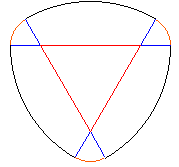
There are many other shapes of constant width. May you think of any? There are in fact curves of constant width that include no circular arcs however small.
Sphere has two sides.
A bug may be trapped inside a spherical shape or crawl freely on its visible surface. A thin sheet of paper lying on a desk also has two sides. Pages in a book are usually numbered two per a sheet of paper. The first one-sided surface was discovered by A. F. Möbius (1790-1868) and bears his name: Möbius strip. Sometimes it's alternatively called a Möbius band. (In truth, the surface was described independently and earlier by two months by another German mathematician J. B. Listing.) The strip was immortalized by M. C. Escher (1898-1972).

To obtain a Möbius strip, start with a strip of paper. Twist one end 180o (half turn) and glue the ends together. For comparison, if you glue the ends without twisting the result would look like a cylinder or a ring depending on the width of the strip. Try cutting the strip along the middle line. People unacquainted with Topology seldom guess correctly what would be the result. It's also interesting cutting the strip 1/3 of the way to one edge. Try it.
Now once you know the trick, surely you would like to find other one-sided surfaces. Before gluing the ends together you can twist the strip twice or even three times. Do you get one-sided or two-sided surface?


Acknowledgments:
